
YTD performance & valuation observations
It is quarter end, this letter provides a brief review of year-to-date portfolio performance, the changes we have made, and some observations on market valuations.
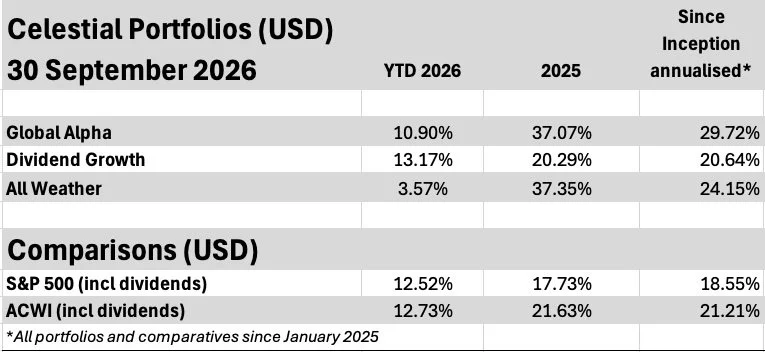
These portfolios are managed on behalf of IBEX Capital (Pty) Ltd, FSP no. 49055
For a reminder of each portfolio’s position on the risk-reward spectrum, its anticipated volatility and the latest factsheet, please follow this link.
Global Alpha Portfolio
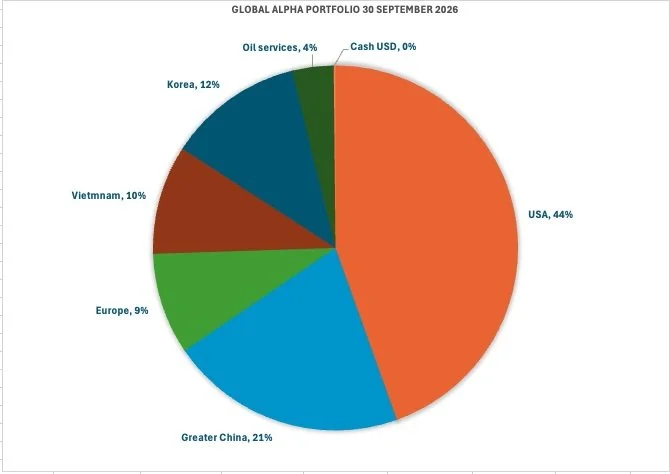
The portfolio is up 10.9% year to date. The main contributors were the Nasdaq, the equal-weight S&P 500 and South Korea, while China was the largest detractor and is now extraordinarily cheap relative to peers. In January, we invested surplus cash from dividends received in 2025 in an Oil Services ETF; that position is up 8% year to date. In July, we reduced the South Korea and US Wide Moat positions and allocated the proceeds to US large-cap shares with high free-cash-flow yields. This 15% allocation excludes hyperscalers and positions the portfolio more defensively ahead of anticipated volatility. We expect to make further changes during the next month, depending on market developments. The portfolio remains well diversified and positioned for growth. Its country and sector allocations at 30 September follow:
Dividend Growth Portfolio
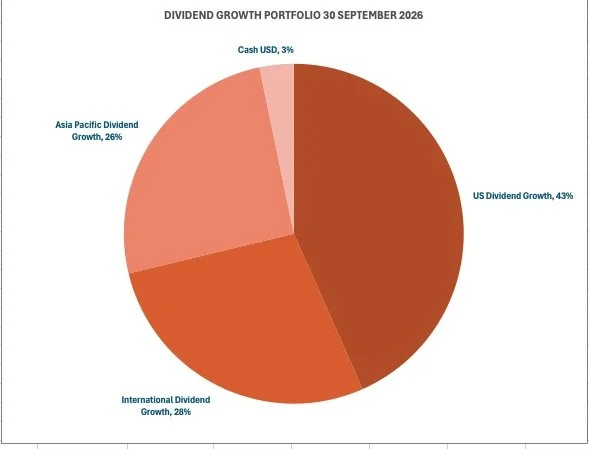
Designed for investors seeking income alongside capital growth, this portfolio holds mature companies with a record of increasing dividends. It is up 13.17% year to date. The main contributors were international and Asia-Pacific dividend growers, which benefited from the decline in the US dollar and solid growth in their underlying businesses. We have made no changes to the portfolio. Its high-level allocation at 30 September follows:
All weather portfolio
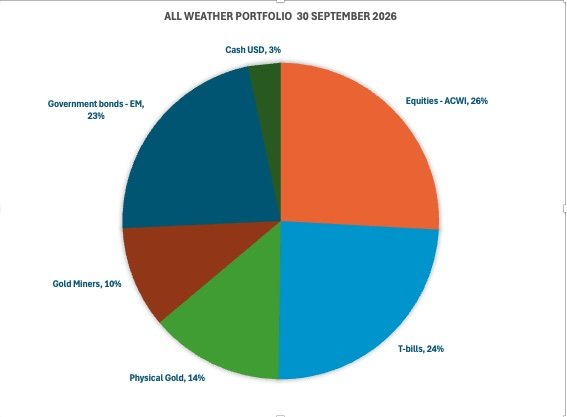
The portfolio invests in highly liquid ETFs across equities, bonds, gold and cash, seeking to reduce volatility through diversification across asset classes. We rebalance its strategic allocation annually and may adjust it when the macroeconomic environment changes. This is our least volatile portfolio—our “stay rich” portfolio. The only change this year was the January rebalancing after gold’s exceptional run in 2025. The portfolio allocation on 30 September follows:
In the markets
A. Bond yields are increasing
Bond prices are falling, which means yields on these fixed-income instruments are rising. A global fixed-income sell-off has pushed the benchmark 10-year US Treasury yield to its highest level since 2002, but the pressure is not confined to the United States. Borrowing costs are rising worldwide: British 30-year government bond yields have reached their highest level since early 1998, while Japanese yields remain near multi-decade peaks.
Those higher borrowing costs are a big pain point for property prices. Just look at Australia. House prices Down Under are already down around 5%
Higher long-term interest rates raise the risk-free rate used to value securities, including listed and unlisted shares. All else being equal, a higher discount rate reduces the present value of expected future cash flows, putting downward pressure on valuations. We expect this effect to become more visible in the months ahead.
B. Mega Cap’s “Other income” = revaluations of unlisted LLM’s
The following chart en certain comments are from FT Alphaville article based on a recent Goldman Sachs report:
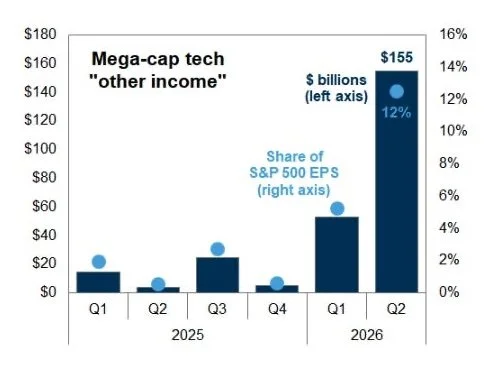
Mega-cap technology companies’ “Other Income” includes increases in the carrying value of illiquid investments in OpenAI and Anthropic. Even when earlier investors did not participate in a new funding round, they increased the balance-sheet carrying values of their investments; the corresponding gain was recognised as “other income” in the income statement.
America’s three corporate growth engines today are AI capex; high margins on semiconductors; and private investment gains. The combination helped lift S&P 500 earnings by 51 per cent year-on-year last quarter, according to Goldman Sachs. Four-quarter EPS growth is currently running at 26 per cent, having averaged 7 per cent during the past 30 years.
OpenAI was valued at $853bn when its last funding round closed in March 2026, and Anthropic at $965bn when its round closed in May 2026. Key investors Microsoft, Amazon and Alphabet collectively own an estimated 30% to 35% of both these companies, (based on a Gemini estimate with references).
OpenAI and Anthropic principally earn revenue by selling compute, priced by the million tokens. Although compute is offered in multiple tiers at different prices, the price of basic compute has fallen by more than 95% over the past 18 months. Strong competition from China is adding further pricing pressure. At the same time, enterprise AI bills have risen because newer frontier models use much more compute to solve complex problems. The net effect on future earnings at the large-language-model level remains highly uncertain making valuations unpredictable.
This brings us back to “other income” reported by mega-cap technology companies. Because Anthropic and OpenAI have announced plans to list, this “Other income” —about $200bn in absolute terms, or 12% of S&P 500 earnings per share in the first half of 2026—is highly unlikely to recur in future periods. Its disappearance would materially affect aggregate S&P 500 earnings and therefore current valuation levels. The following graph shows realised and consensus year-on-year EPS growth, according to Goldman Sachs:
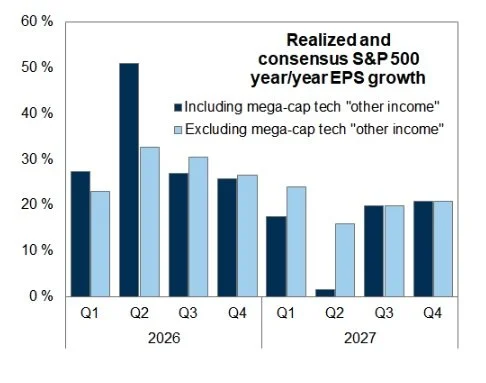
Investment and economic cycles will continue as before, the disproportionate “other income” that is currently in the cycle is highly unlikely to be repeated; overall capital expenditure on compute may return to more normal levels in the years ahead. If the listed prices of Anthropic and Open AI don’t meet their current very lofty valuations, overall, the S&P 500 may appear very expensive at current levels.
Microsoft, Alphabet and Amazon may experience a quarterly blip if the LLM’s valuations don’t meet expectations but these three should be some of the major long term beneficiaries of the AI spend through their growing cloud revenue and the tangible enhancements that AI is bringing to their already dominant offerings.
Another interesting aside is the introduction of IFRS 18 which is compulsory for all financial years commencing on or after 1 January 2027. This complies the mandatory categorisation of income and expenses between Operating, Investing and Financing. The first reporting date for IFRS 18 will be Q1 2027, together with comparative numbers for 2026. Other income and expenses will now have to show all the detailed elements that they comprise. There will be no ambiguity what other income is and how repetitive it will be. The accounting profession for once will improve our lives with this change, we can now compare apples to apples!
The circular financing that has been taking place between the hyperscalers, chip manufacturers and the rest of the AI ecosystem is opaque and could have significant implications for valuations if some of the weaker links do not survive or breach some of their loan covenants. These are complex arrangements and this FT article, especially the interactive graphic titled “An interconnected ecosystem of $3.6tn of disclosed commitments” makes for fascinating reading.
Taken together, these factors increase uncertainty and could produce higher volatility over the short to medium term. We are making no changes to the All-Weather or Dividend Growth portfolios because they have limited exposure to the market’s most overvalued areas. In the Global Alpha Portfolio, however, we plan to reduce the Nasdaq 100 position and reallocate capital to undervalued areas with the potential to grow over the next 12 to 18 months.
Transitioning back office
This will be my final update sent directly from Celestial. All portfolios except those of our Swiss clients have now migrated to IBEX Capital, and future updates will come from me in my capacity as portfolio manager at IBEX. As explained in previous letters, increasingly demanding compliance requirements made this change sensible. I will continue to manage the portfolios, while the IBEX team handles the operational and administrative functions.
I would like to thank all clients for their patience with the additional administration involved in migrating their accounts. I believe the benefits of the transition will become increasingly clear in the years ahead.
The IBEX team deserves special recognition for its hard work in completing the portfolio migrations and for its commitment to expanding Interactive Brokers’ presence in South Africa. Interactive Brokers remains, in our view, the leading global platform for execution quality and transaction and custodian costs.
Conviction, humility and discipline, to those ends we work.
Yours truly
Chris
Risk Disclosure
The portfolios are managed on behalf or IBEX Capital (Pty) Ltd, (FSP no 49055). The portfolios serve as a model for IBEX’s clients, clients portfolios may differ due to different entry points.
Investing in financial markets involves inherent risks, including the possible loss of capital. The performance of the Celestial portfolios, as presented in this report, reflects historical results and should not be interpreted as a guarantee of future returns. Market conditions can change rapidly due to a variety of factors, including economic developments, geopolitical events, changes in interest rates, and fluctuations in currency and commodity prices.
Each portfolio is constructed with a specific risk profile in mind, but all investments are subject to market volatility. Portfolios with higher allocations to equities or emerging markets may experience greater fluctuations in value, while those with exposure to fixed income or alternative assets, such as gold, are not immune to periods of underperformance or loss.
Past performance is not indicative of future results. Investors should carefully consider their own investment objectives, risk tolerance, and time horizon before making any investment decisions. We recommend consulting with a qualified financial advisor to ensure that any investment is appropriate for your individual circumstances.
The information provided in this report is for informational purposes only and does not constitute investment advice or a recommendation to buy or sell any securities. Please refer to the portfolio factsheets and legal disclosures for further details.